Zeyde
Jacob's LadderZeyde is Jacob’s grandfather, remembered through a distinctive voice, shared journeys, and a family history whose costs Jacob does not fully grasp until later. Though dead by the time of the novel’s present action, he remains more than a figure in recollection: in a moment of physical crisis, Jacob hears a voice that brings him to mind and addresses him as if he were there. The uncertainty of that encounter gives Zeyde’s continuing importance its particular shape—he is absent, but the bond with him still offers Jacob a point of recognition and comfort.
Identity and Family History
Jacob remembers Zeyde’s voice as a lightly accented tenor. Even an unfamiliar voice can recall him: when someone calls Jacob back to consciousness, its paternal sweetness reminds Jacob of his grandfather. The memory is not only a matter of words or resemblance. It carries the sense of care that Jacob associates with Zeyde, so that the voice becomes a link between the immediate danger and a person who has already been lost.
Zeyde’s death precedes the novel’s present-day conversations about Jacob’s family. Jacob explains that he returned from Israel after his grandfather had died, and that the family he had left was in the United States. The statement places Zeyde at the center of Jacob’s decision to go abroad: Israel mattered to Jacob in part because it was where he could be with his grandfather. His connection to the country was therefore personal rather than an expression of a political or religious commitment. Jacob says he is glad they went, but does not share Zeyde’s desire to belong there in the same way.
Shared Journeys and the Family Past
A remembered excursion to the water off Sandy Hook offers a glimpse of the ordinary intimacy between grandfather and grandson. Zeyde borrowed a car from a man he worked with at an appliance store and drove Jacob to New Jersey. The recollection preserves specific circumstances—the borrowed car, the work connection, and the destination—rather than presenting their closeness only as a general sentiment. It places Zeyde in the role of someone who made a journey possible and shared it with Jacob.
The family past also includes a departure that leaves a stark absence. When Jacob and his family got home, his father was gone, along with every trace that he had existed: clothes, equipment, photographs, records, tools, letters, and paperwork. The account does not identify Zeyde as the cause of that disappearance, and the two details should not be collapsed into one event. Together, however, they establish the broken family history within which Jacob’s attachment to his grandfather carries unusual weight. Zeyde is remembered as a person Jacob could be with, while the missing father is represented by the objects removed from the home.
Israel and the Cost of Staying
Jacob’s later conversation with Dan revises his understanding of the years he and Zeyde spent together. Dan tells him that Zeyde had never planned to leave Israel until Jacob finished college, and that Jacob accelerated his grandfather’s timetable by about six years. Jacob is surprised to learn this. The revelation makes their shared life abroad newly legible: what Jacob had experienced as going to Israel to be with Zeyde also involved Zeyde postponing his own departure for Jacob’s sake.
That change in perspective complicates Jacob’s memory without diminishing his gratitude. Israel had filled a void in Zeyde’s heart, while Jacob did not feel the same pull to belong there. The difference matters: their life together was held by affection, not by identical attachments to a place. Zeyde’s willingness to remain until Jacob completed college gives that affection a concrete duration and a consequence. Jacob’s later knowledge that he shortened the stay by six years is not simply biographical information; it changes what he understands the shared years to have meant to his grandfather.
Presence in Memory and Crisis
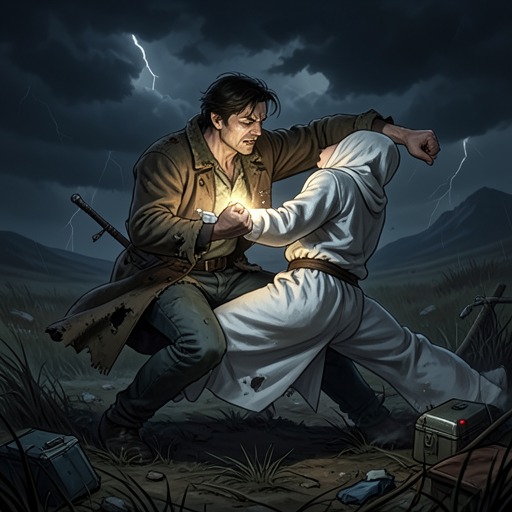
During a collapse, as Jacob struggles to lift his eyelids and a light briefly blinds him, an unfamiliar voice urges him to come back and asks whether he can hear. Its paternal quality brings Zeyde to mind before Jacob can be sure who is speaking. In that disoriented state he identifies the presence as his grandfather and connects his own struggle to the story of Yaakov wrestling with an angel. When he lashes out with a foot and hands hold it down, he jokes that God must have sent more than one angel. The scene holds physical confusion and recognition together: Jacob is not calmly recounting a memory but trying to interpret what is happening as he is being reached and restrained.
Jacob later thanks Zeyde and says how much he has missed him. He squeezes his grandfather’s hand and speaks as though Zeyde is the person beside him. The scene does not settle whether the encounter is supernatural; its force lies in the way Jacob experiences the voice and hand through the bond he remembers. A later recognition makes the boundary between memory and the present sharply visible. Greeting JT, Jacob recognizes the fingers he had touched the night before and the palm he had kissed when he thought it was Zeyde, then registers that JT is nothing like his grandfather. The mistaken identification does not erase the distinction between them. Instead, it shows how powerfully Zeyde’s remembered presence can surface in Jacob’s bodily experience, while the recognition of JT restores the difference between the living man before him and the grandfather he has lost.